The Best Guide to Scholarships
Read time: 5 min · Last updated: June 21, 2026
A high ACT® Score can help students earn scholarships. There are many scholarships available. This guide discusses where to find relevant scholarships, how most students tend to find success, and how to avoid scams.
There’s a lot of confusion around scholarships. According to Sallie Mae:
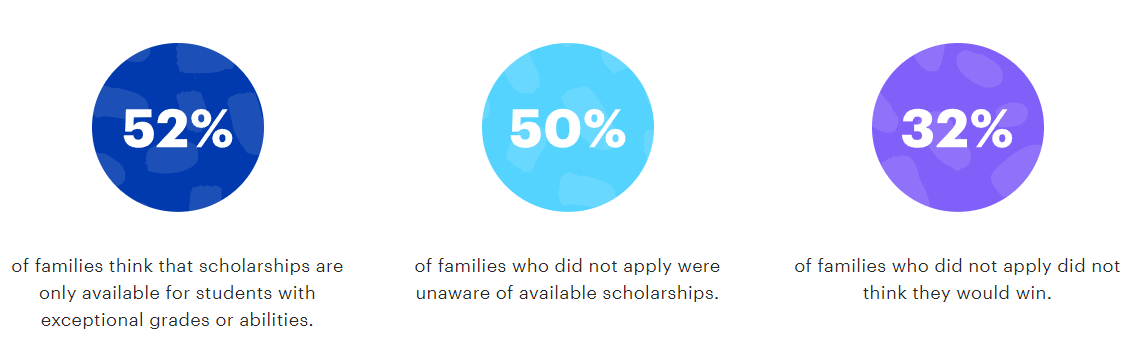
This guide will help families dispel notions around scholarships and hopefully lead more people to take advantage of these opportunities. There are 4 main types of scholarships: needs-based, merit-based, athletic, and ROTC scholarships.
The types of scholarships as a whole are important, but the easier way to think about them is by figuring out which strategy makes most sense for your family’s situation. The guide below reviews the different strategies in depth.
How to Avoid Scams
Unfortunately, some people want to prey on families looking for scholarships. There are some general rules to follow when applying for scholarships. As always, use your best discretion, search for reviews, and remember:
- Don’t pay for a scholarship.
- Don’t fall for guarantees.
- Don’t give anyone your credit card, social security number, or bank account info.
The point of a scholarship is to give money away. If you find a scholarship asking for money, that’s a huge red flag, especially if the scholarship is asking for money upfront. Why would they make people pay if the scholarship had money to give? Similarly, don’t fall for any service that guarantees scholarship success.
There’s no way to ensure a student receives a scholarship, as each award is granted at the discretion of individual human beings who are under no obligation to listen to whomever you may pay for “guaranteed results.” Besides, if you could pay to get scholarships, everyone would do that – and then there’d be no scholarships left.
Scholarships from Local Colleges
This strategy has worked well for students with a competitive application. The first step is to search for colleges based on location rather than another factor such as national ranking, course offering, or campus offering. Those three concerns can still influence college choice. The point is that applying to colleges nearby can save money for a variety of reasons.
If a student has a competitive application and applies to a school where he or she is at or above average, merit-based financial aid becomes much more likely. To understand why, it’s necessary to understand how most colleges distribute financial aid. A lot of colleges (not all) offer financial aid in tiers. Each school usually creates a student profile that contains facts such as GPA, ACT®/SAT® scores, extracurriculars, application details, etc.
Then the first 5% or so of students are offered a portion of financial aid. Once that tier has been given its award offers, then the financial aid office moves on to the next tier, maybe 10-15%. And so on and so forth, through the 25%, 50%, and to all the rest.
A student can leverage his or her application by using the above knowledge on how colleges grant financial aid. As a general rule, applying to schools where a student is in the top 5%-25% can yield more financial aid.
Finding Local Colleges
To find schools where a student’s application is competitive, a lot of people search within a radius of their home. The government has even created a free tool to search for colleges within a certain radius of a person’s address.
National Center for Education Statistics Free College Navigator
Enter in the maximum distance of 250 miles around your zip code. To see how a student’s application may rank at a particular nearby college, get a list of colleges from that link, then search for “freshmen profile at {college name} 2026.”
Most universities release such information. Then, applying to those nearby colleges where a student is in the upper percentiles of a freshmen class can be a great way for colleges to give a student a lot of money in scholarships.
Colleges want to attract the best students they can. One way they do this is by making the most generous offers to the students with the most competitive applications.
Home for the Holidays
Another way this strategy can save money, besides the amount of money saved in scholarships, is by allowing easier travel home. Students often come home for Winter and Summer Break. They may come home for Thanksgiving, Spring Break, or any time they feel they want to.
If a student is within 250 miles of their home, it’s much more affordable for them to come home. A few plane tickets a year can easily cost another $1,000-2,500 in addition to college, which can be a difference of $4,000-10,000.
Needs-Blind Admission
An important caveat to the conversation on merit-based scholarships is “needs-blind” admission or income thresholds. If a family is comfortable discussing finances with their children, they can optimize for schools with this policy. Basically, a college will cover 100% of tuition, and sometimes board and other expenses, for students from families with income under a certain threshold.
If this is important to you, search for colleges with needs-blind admission. Each university will explicitly list its specific requirements and awards, so there shouldn’t be any surprises if a student is admitted.
National Merit Scholar
The National Merit Scholarship can be easily misunderstood because it portrays itself as being more straightforward than it actually is. I’ll break down the steps involved, and what that means when calculating whether a student can count on this scholarship.
- 1. First, you need to take PSAT/NMSQT®. Each year, about 1,500,000 students take the PSAT®. Overall, 7,580 students win, which is roughly 0.005% of all students who take the Test. Sign up for the PSAT® here
- 2. 50,000 high scorers are selected. The NMSC® takes the top 50,000 scorers and notifies them.
- 3. 16,000 semifinalists are then selected. Out of the top 50,000, 16,000 semifinalists are calculated on a state-by-state basis. There are maximums calculated for each state. NMSC® notifies the students’ schools.
- 4. 15,000 finalists are notified. From the 16,000 semifinalists, 15,000 are selected as finalists. The NSMC® makes sure the students’ scores are accurate, and that the student attends a high school in the US (or meets other requirements). Finalist requirements details.
- 5. Then, final winners are selected. 6,870 National Merit and 710 special scholarship winners.
National Merit Scholarship Award Amounts
The awards break down as follows. Students do NOT win each of the following. Usually, they win one or the other, National Merit® or a corporate-sponsored scholarship. Then, a college may or may not have a further scholarship based on the National Merit® Scholarship.
- National Merit® $2500 Scholarships
- Corporate-sponsored scholarships. These scholarships are either for all winners, or for residents of communities or children of employees. See the full list here.
- College-sponsored scholarships. Each year colleges and universities support about 3,600 Merit Scholarship awards for Finalists who have been admitted to and will attend their institutions. The award varies from school to school, and is received in addition to National Merit® Scholarship. Source
Final Thoughts On National Merit
The National Merit® Scholarship is incredibly competitive. Many people don’t realize there are steps beyond just taking the PSAT®. It’s a statistical fact that most students taking the PSAT® Test won’t win it. But someone has to earn the scholarship. Don’t let the odds dictate your decision.
ROTC Scholarships
ROTC stands for Reserve Officers' Training Corp. Most people pronounce it like ‘Roxy’ but with tze at the end like in ‘Yahtzee’, like “Rotzee.” Each program offers financial aid options to cover up to the entire cost of college, and, in some cases, living expenses.
Upon completing an ROTC program in college and graduating, students are commissioned as officers in their respective branches: Army, Navy, Air Force. Each ROTC program has its individual requirements. A part of the application for each is SAT® or ACT® score.
Army
According to ROTCConsulting.com:
The Army’s own ROTC page is here. It’s a little lighter on details. If your family is considering Army ROTC, try to talk to someone who has considered the program before.
Navy
The Navy’s ROTC Page has a comprehensive overview of its program. The test score requirements for the Navy ROTC scholarship are as follows:
Air Force
The Air Force ROTC Scholarship has the highest requirements out of all branches. Regarding test scores, the Air Force says, "SAT composite of 1240 or ACT composite of 26. Super scores are not accepted."
ROTC Schools
It’s important to keep in mind that while many schools have ROTC programs, not all schools have every branch of ROTC. Choosing to pursue an ROTC scholarship can limit a student’s options for where to study, though the program may offer the student many other advantages.
Sports Scholarships
According to the NCAA, “Only about 2% of high school athletes are awarded athletics scholarships to compete in college.” Student athletes may receive academic scholarships as well. There are several different leagues of sports that offer different kinds of financial aid.
NCAA
The NCAA is the sports league most people are familiar with. There are three divisions within the NCAA: D1, D2, and D3. Division 1 has the largest schools. Athletic demands will be greatest the closer a student is to Division 1. D1 and D2 schools can provide athletic scholarships, but D3 can’t. The best place to start is the NCAA’s homepage.
NAIA
The National Association of Intercollegiate Athletics organizes sports for smaller colleges. They award $1.3B in scholarships annually. The NAIA webpage for financial aid offers little guidance, as actual dollar amounts depend heavily on the specific school.
State Entitlement Awards
Many students are unaware that some States have a specific entitlement award. The requirements vary greatly from state to state. A lot of states require a student to proactively claim it.
- California has Cal Grant. Cal Grant website.
- Virginia has the Guaranteed Assistance Program. Virginia Guaranteed Assistance Program.
Local Scholarships May Be Your Best Bet
Most students report the greatest success pursuing scholarships in their community. It makes sense: there’s more opportunity with less competition. Here are some places a student can check:
- Guidance Counselors — It is their job to know who is trying to give money to college-going seniors in your area.
- Community Organizations — Kiwanis, Rotary, Lions Club often offer scholarships to serve the community.
- Student Clubs & Interest Clubs — Equestrian societies, intramural sports, etc.
- Parent's Employer & Union — Some employers offer scholarships to students of parents employed there.
- Parent's Military Service — The GI Bill pays for college. GI Bill Transferability details.
- Religious Organizations — Local churches, synagogues, and mosques tend to provide scholarships to members.
- Local Government — Search your local government’s name + scholarship.
- Local Newspaper — Check local papers for community members advertising scholarships.
Ethnicity-based Scholarships
- NAACP — List of scholarships.
- HSF — Hispanic Scholarship Fund.
- IHS — For American Indian and Alaska Native students in health care.
- NIAF — For Italian Americans.
- Arab Americans — List of scholarships for Arab Americans.
Aggregators
Only try aggregators once local options are exhausted. The big two to look at are the College Board’s and the ACT’s scholarships.
- The College Board’s scholarship search engine
- The ACT® Inc.'s list of reputable scholarships
- Unigo
- FastWeb
- Sallie Mae's Scholarship Page
Conclusion
There are so many options to pursue for scholarships. My best advice is to go try something. Many families don’t apply for any. This article has given many ideas for places to start looking. I hope it helps people find relevant scholarships.
Are there any scholarships, tips, or advice you want other parents to know about? Feel free to reach out.