Is ACT® Tutoring Worth It?
Read time: 6 min · Last updated: June 21, 2026
Your kid's test score is low, so you're starting to wonder: is tutoring worth it? Obviously, this is an article published on a tutor's website, so I'm going to say yes — except with huge, huge caveats. Below is the scholarly research, along with numbers from real colleges, so you can see for yourself if ACT tutoring is worth it.
What the research actually says about tutoring effectiveness
When talking about the effectiveness of tutoring, most people talk in terms of "standard deviations." You don't need to know the formal math definition to understand how they work — and they're the key to understanding any honest claim about tutoring.
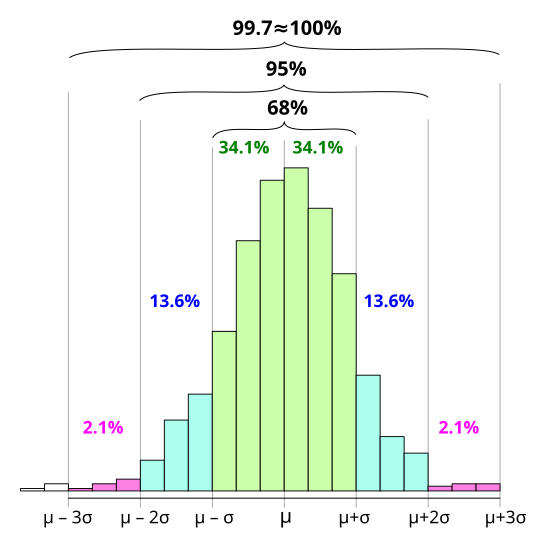
When you have normally distributed data, it falls into a bell curve like the one above. (Called a bell curve because it looks like a bell and is a curve.) Each standard deviation away from the mean — the average — represents a fixed share of the data. Within 1 standard deviation of the mean, you have 68% of all values. Within 2 standard deviations, you have 95%. Within 3, you have 99.7%.
Here's why that matters. If a tutor moves a student up by 1 full standard deviation, a kid sitting exactly at the average jumps from the 50th percentile to the 84th. (The 68% of students within 1 SD of the mean is split evenly on either side — 34% above the mean, 34% below — so a +1 SD move adds that 34% to your starting 50th percentile.) On the ACT, the 50th percentile is about a 19 composite and the 84th is about a 26 — so one full standard deviation works out to roughly a 7-point jump.
In 1984, Benjamin Bloom, an educational psychologist at the University of Chicago, wrote a famous essay arguing that tutors offer "the best learning conditions we can devise." Bloom claimed tutoring could raise student achievement by two full standard deviations. For the ACT, two standard deviations means taking a student from a 19 to about a 33. That is really, really hard. I'm not saying it never happens — I've done it — but it is not the expected norm, and no serious study has ever reproduced it.
In fact, the studies suggest the real average is far lower. Many tutoring companies still cite a 2020 working paper that found general academic tutoring produced an improvement of 0.37 SD — but the same authors revised that figure down to 0.288 SD in the peer-reviewed version published in 2024. On the ACT, that works out to an improvement of roughly 1.5 points on the composite.
So according to the best available evidence, tutoring is one of the most reliably effective interventions in all of education — but the honest word for the effect is "substantial," not "miraculous." The same 2024 analysis is what buries Bloom's two-sigma claim: across 96 studies, not one reproduced a two-sigma effect.
Population averages like these also lump together every delivery format — and the format matters enormously. A lot of what those studies measured was self-directed or lightly supervised work, which is a genuinely different thing from one-on-one ACT tutoring. If you want to figure out which side of that line your own child falls on, my self-study vs. tutoring diagnostic walks through it honestly — and if the answer is that your kid is the self-directed type, the ultimate self-study guide for the ACT lays out a full plan, as does the question I get constantly: is there a Khan Academy for the ACT?
A fair question, then: why do I guarantee a 4-point increase, or a 31, or your money back? Two reasons. First, those population averages include every kind of tutoring program — volunteer, group, after-school, lightly supervised — not focused one-on-one ACT work with a student who actually does the assignments between sessions. Second, I don't take every student; the guarantee reflects students who come in with a real target and the willingness to put in the work, which is a very different group than "everyone who was handed a tutor in a research study." Improvements north of a full standard deviation are something I see regularly under those conditions.
Of course, the guarantee is only as good as the tutor behind it, and not every "specialist" is one. If you're evaluating me against other options, how to find the best ACT tutor lays out what actually separates a real specialist from a script-reader, why an online ACT tutor tends to outperform a local one, and — if your test date is barreling toward you — whether last-minute ACT prep in 2–4 weeks can realistically move the needle.
Sources
What ACT® tutoring actually costs (2026)
For the full breakdown, see my pricing page — or, for the wider market context, how much ACT tutoring costs across providers. Here's the quick reference, so you can weigh the price against the scholarship savings a higher score can unlock in the next section. If you're still deciding between formats, my breakdown of group versus private tutoring covers which one the research actually favors.
| Option | Typical price |
|---|---|
| Generalist tutoring aggregators | $45–$100/hr |
| Specialized ACT/SAT tutors | Often start at $100/hr; realistic spread $40–$200+/hr |
| Kaplan packages | ~$800 (5 hrs) up to ~$4,400 (40 hrs) |
| PrepScholar / Princeton Review | Priced above Kaplan |
| Big-company comprehensive packages | $2,000–$3,150+ |
| My packages | $675 for 5 sessions, $1,275 for 10 |
My packages sit below the national-brand comprehensive packages while still buying you a specialist's hourly attention rather than a college student reading from a script.
And if the sticker price is the real obstacle, don't stop here — a lot of what families pay big companies for is just information that's already free. I lay out ACT prep on a budget and the insider knowledge most families never get without a $300/hour tutor, and it's worth knowing that ACT tutoring is occasionally tax-advantaged depending on your state and accounts.
Sources
The ROI threshold — scholarships
You can calculate the return on tutoring fairly precisely, because it comes down to the scholarship thresholds at the specific schools your child is targeting. This is exactly why a student needs to start studying with a concrete goal in mind. Without knowing the number your son or daughter is aiming for, the rest of this section is impossible to personalize — I break down which scores unlock which awards on my free tutoring page.
Take the University of Alabama, which publishes an actual automatic out-of-state merit table tied to GPA and ACT bands. Every threshold you cross is worth real, measurable dollars:
| Award | Value |
|---|---|
| UA Scholar | $24,000/year |
| Presidential Scholarship | $28,000/year (~$112K over four years) |
| Presidential Elite Scholar | Full tuition for four years + first-year housing + $1,500/yr supplement + $2,000 study allowance |
Here's how the math works for a UA-bound student sitting right at the line. Moving up a single composite point near the cutoff bumps you from the $24K tier to the $28K tier — that's $4,000 a year, or $16,000 over four years, for one point. A $1,275 package against a $16,000 swing is roughly a 12:1 return. And a single point, for a motivated student near a threshold, is very gettable.
The same logic plays out in the big merit states — and if you're in Georgia or Florida, the dollars are even more concrete. Georgia's Zell Miller Scholarship pays 100% of in-state tuition for residents who clear its threshold. Florida's Bright Futures is a two-tier cliff: the Medallion tier covers 75% of tuition and the Academic Scholars tier covers 100%. In both states, a few points is the difference between paying nothing and paying full freight — which is exactly the kind of gap targeted tutoring is built to close. I break down the state-by-state thresholds, including Georgia and Florida, on my free tutoring page.
Every school sets its own thresholds, so the broader landscape is worth knowing. Entry-level merit awards commonly kick in around a 24–26 composite, expanding notably at 28+, and some schools post full-tuition automatic awards as low as a 22–26 ACT — though most full-rides still want 28 or higher.
One honest caveat: these test-based grids are still common at large public universities, but plenty of schools have shifted toward GPA-only or test-optional automatic awards. So don't assume the school on your list works like Alabama — pull up that specific school's current scholarship grid and confirm the threshold before you build a plan around it.
Sources
- https://afford.ua.edu/scholarships/out-of-state-freshman/
- https://afford.ua.edu/scholarships/international/
- https://www.myscholarhq.com/university-of-alabama-scholarships/
- https://www.road2college.com/university-of-alabama-merit-scholarships/
- https://gsfc.georgia.gov/hope
- https://www.larrylearns.com/blog/bright-futures-scholarship
- https://prepexpert.com/act-score-for-scholarships/
- https://collegeaidpro.com/what-act-or-sat-score-will-get-you-a-full-ride-scholarship-to-the-school-of-your-dreams/
- https://prepexpert.com/a-complete-guide-to-guaranteed-sat-and-act-score-scholarships/