The #1 reason students get demotivated studying for the ACT is they lack a clear goal. Before studying for the ACT, your son or daughter should have a concrete number in mind. It shouldn’t be "as high as possible." Nor should your son or daughter aim for a 36 “just because.” He or she needs a specific number tied to a specific set of colleges. I’ll show you how to find that number.
Make a List of Schools
First, you and/or your son and daughter need to sit down and figure out which schools he or she may like to attend. Generally, I see students make a list of about 9 schools: 3 reach, 3 targets, and 3 safeties.
My example list is below. Remember that a safety school for someone is a reach school for someone else. You can get an excellent education anywhere.
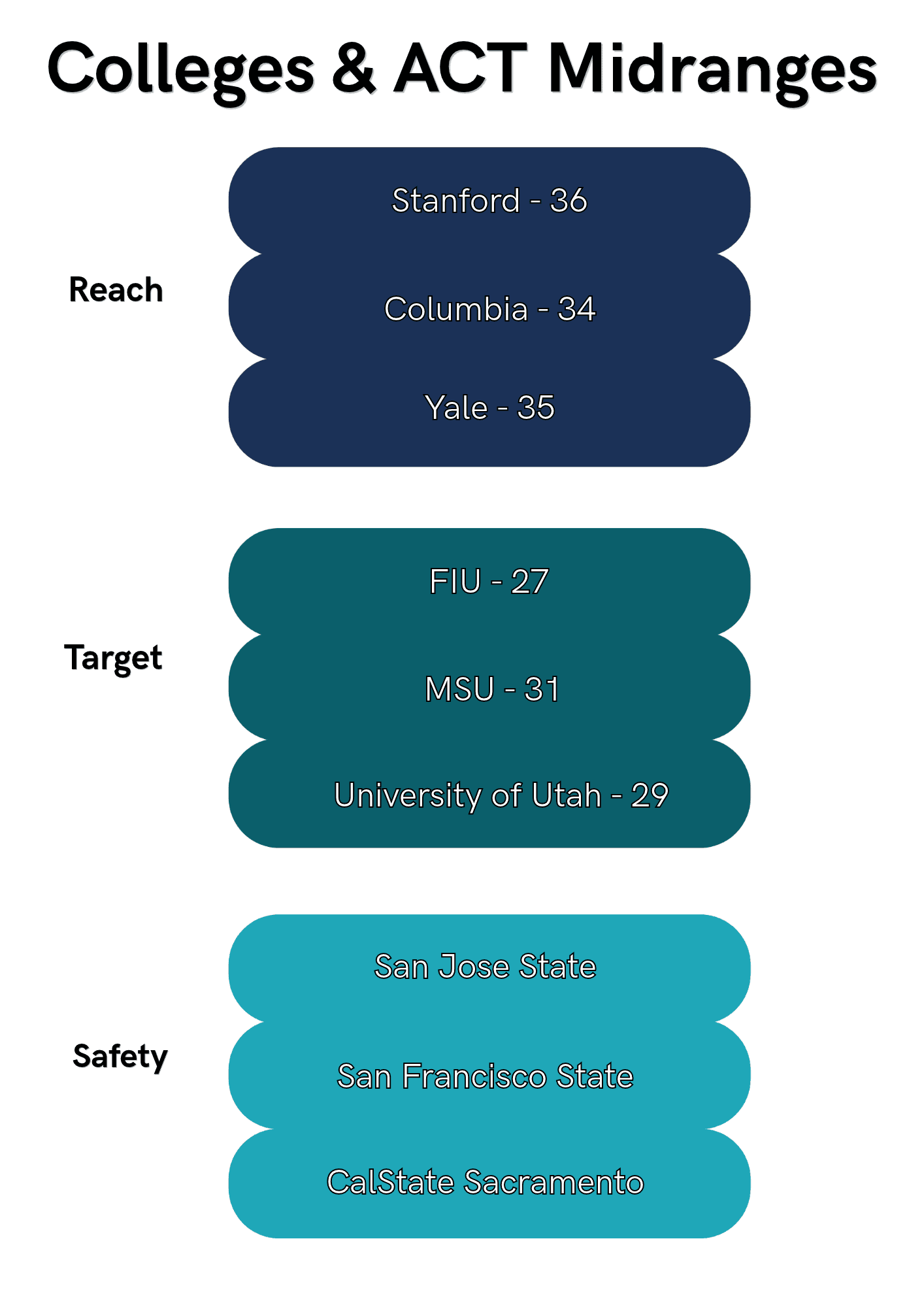
Example List
The idea behind this list is that a real student could have made it.
Let’s call the student Rajeev. He lives in the Bay Area and wants to study international business. Stanford, Columbia, and Yale might be good places to study business or business-related fields - but they all seem out of reach currently.
Florida International University, Michigan State, and University of Utah all have good international business programs, and they’re within his realistic score range, so those are all solid options.
San Jose State, San Francisco State, and CalState Sacramento are all close to his home in the Bay Area, so they serve as solid back up options. These schools do not consider test scores for college admission. Instead, those colleges weigh the required coursework and GPA more heavily.
Finding Midrange Scores
Most colleges publish online the ACT® score range for their admitted students, usually the 25th through 75th percentile. This is called the middle 50%, or the midrange. You can find it by searching: "[College name] Common Data Set" and looking at Section C9, or by checking the college's admissions page directly under something like "Class Profile."
The number you want is the 75th percentile. That is the score that puts your child in the top quarter of admitted students by test score - where an ACT® works clearly in your son or daughter’s favor rather than just clearing a bar. If the middle 50% at a school is 26–31, the target is 31. Of course, test scores aren’t everything. Some schools put less weight behind standardized test scores; other schools put more weight behind them. The situation could also be different if you’re an international student, homeschooled, a student athlete, and so on. All of these considerations are part of the college admissions puzzle.
How Test Optional Policies Impacts Planning
You might be thinking - 90% of schools are test optional now - so do we need to even take the ACT?
Maybe, maybe not.
But realistically, your son or daughter likely does need to take the ACT or the SAT. If one college on the list requires the test, then the test is required. If taking the test will be considered at even one school, then the test should be taken.
Colleges are returning to test required. Movement is coming from the most elite universities, where colleges found that test optional actually hurts lower income students - the exact population test optional was meant to help. For this data, Brown and Dartmouth cite their own research.
Columbia, Princeton, Claremont McKenna, Vanderbilt, and Notre Dame are all returning to test mandatory admissions. 2,300 UC faculty signed a petition to urge the system to return to test required for STEM majors.
Many schools are re-instating test policies. The effect will likely be about an additional 10-15% of schools requiring the test in the next 2-3 years. Meaning that maybe 75-80% of schools will remain test optional or test blind.
But test optional has never meant test not considered - test blind means test not considered. Fewer than 5% of schools are test blind - many of those schools are the above mentioned UC and CSU Schools.
So what does that mean for parents and students trying to plan whether to take the ACT or SAT? It means that most students will still need to take a standardized test. The finer details vary wildly from school to school. All of this is verifiable in any school’s common data set information, if they publish it.
Some colleges “consider” the ACT, while others “require” it. Different departments within the same schools can have different benchmark: the Honors College might do something different; the engineering school might do something different; and so on with the business school, and all the rest.
Making a list of the schools your son or daughter wants to attend and then identifying what those schools value has never been more important.
Possible Score Inflation
Since most schools are genuinely test optional, most submitted scores tend to be higher than recent, even though the national trend is that ACT scores are going down.
A college that used to have a midrange of 24-27 might now have a midrange between 30-32. MSU’s own pages show its middle 50% moving from 24-30 for fall 2023 to 26-31 for fall 2025. Oregon State is another example, with only about 12% of enrolled first-years submitting scores.
That doesn’t mean the school got more competitive. It means the college has a higher average test score because students with better scores submit them and students without better scores don’t submit them.
Within the next 5 years, I would expect test scores to deflate significantly as more schools return to requiring standardized test scores for admission.
Scholarships & Standardized Test Scores
Admission and scholarship eligibility are separate numbers. The scholarship threshold is usually, but not always, the higher one. A school might admit students with a 24 but reserve meaningful merit aid for students at 28 and above - larger awards are sometimes available at a score of 31 and above.
Look up the merit scholarship page for each school on the list separately. If cost is a factor in the college decision, the scholarship threshold may become the real target, not the admissions range.
To find this information, try searching for "[College name] merit scholarships" or, to surface guaranteed awards, "[College name] automatic merit scholarship requirements.”
You can also check out my guide to scholarships: Scholarships cluster page
Get a Benchmark by taking a diagnostic test
Have your son or daughter take a timed, full-length practice test to find out where your child is starting from. The gap between the baseline score and the target score is what the preparation plan needs to close. It’s that simple.
Please do not start studying if you don't have a baseline. This is the #1 reason students become unmotivated. Give them a baseline, build a plan, and have them study to reach that plan in specific. Your teen doesn’t have time to study into the void. Make things easy for them and you.
If the gap between baseline score and desired score is small - two or three points - focused self-study on specific weak topics can often get there. Everything on this site is organized by topic so that studying is targeted rather than scattered.
If the gap is larger, or if your son or daughter has self-studied and plateaued, that's typically when working with a tutor becomes the most efficient path. A student who already knows their baseline and their target comes into tutoring ready to move fast: there's no time spent diagnosing what's needed because the data already shows it.
Either way, the target score is where everything starts for tutoring purposes. Find the number first, then build the plan around it.