For many ESL students the barrier isn't English ability — it's time pressure, confidence, and a test built around cultural defaults not yet absorbed. The clock running out mid-section. The student understood the passage, knew the answers, and still left questions blank because they read more slowly in a second language. They walked out thinking "I'm not smart enough for this test," when what actually happened is the test gave everyone the same clock regardless of whether they're reading in their first language or their fourth.
This is the situation I see with many ESL students. The sponsor of a student I worked with put it perfectly:
"[The student] entered the USA with no English at 13 years old. Alex went beyond the call of duty to understand how she was learning and what barriers she was putting up — the cultural and confidence issues, the way she'd hide so she wouldn't feel dumb. His insights matched my own observations. He was right on target. I'm impressed."
Each barrier has a concrete answer, and one — the one almost nobody tells EL families about — adds 50% more time to every section, half again as long to read, translate, and answer. The ACT provides robust ESL support, including word-to-word translation dictionaries, one-and-one-half time so students have time to translate, and other possible accommodations.
I'll go over all the available accommodations below, as well as outline some test prep insights that are specifically relevant to ESL students.
ESL Support
ESL support is available to students in the US and Puerto Rico who are enrolled in an EL program or have documented limited English proficiency. That means this program is not for international students who are still abroad or who come to the US for an exchange year. This program is designed for students with limited English proficiency who live in the United States.
ACT English Learner supports are real, underused, and easier to qualify for than people think. This quote is direct from ACT's policy page: "ACT recognizes the need to expand access to English learners. ACT provides supports on the ACT® test to US students who are English learners. These supports are designed to improve access and equity for those students whose proficiency in English might prevent them from fully demonstrating the skills and knowledge they have learned in school."
What's available
- One-and-one-half time, +50% (the only EL support requiring central ACT approval)
- Authorized word-to-word bilingual dictionary (school can approve directly)
- Translated test directions (school can approve directly)
- Small group testing (a designated support — but at a national test center it rides along with the extended-time request and isn't available without it)
Eligibility is enrollment in an EL program OR documented limited English proficiency — a substantially lower documentation bar than ADHD or LD accommodations. And as of 2025-2026, EL extended-time approvals are valid for two years instead of one. A request submitted in the 2025-2026 school year carries an expiration of July 31, 2027, which means a sophomore or junior who qualifies generally doesn't have to re-apply before they're done testing.
There are real accommodations available to learners of the English language. The ACT wants to see those students succeed, which is why they provide these accommodations with such a low burden of proof — other accommodations, such as for students with ADHD for example, require years of documented proof and approval through the ACT organization itself. As of 2026, the bilingual dictionary, translated test directions, and small group testing are all classified as designated supports a school's test coordinator can approve locally; only one-and-one-half time still needs ACT authorization through the TAA system, which the school submits on the student's behalf.
One question parents almost always ask, so let me answer it plainly: scores earned with EL supports are not flagged. A college sees an ordinary score report. Using the support your child is entitled to does not signal anything to admissions.
A note on the dictionary, because this is where families trip up: only word-to-word dictionaries on ACT's authorized list are allowed. Newer editions of many dictionaries now include definitions, pictures, grammar notes, or cultural information — and ACT prohibits any dictionary with that kind of content. The student brings their own approved dictionary on test day; the testing center will not have one. Showing up with the wrong dictionary, or one not on the list, is treated as prohibited behavior and can void the score. Check the title against ACT's authorized list before test day.
I'd recommend more students than not take advantage of small group testing. Some ESL students can be sick of being constantly separated from their peers. I get that. But what would make those students feel more separated is taking one-and-one-half time, using a foreign language dictionary, and having to sit in the same room as their peers.
→Read more: ACT Accommodations — What Most Parents Don't Know
Why the Enhanced ACT® Is Structurally Friendlier to Non-Native Speakers
The Enhanced ACT® is structurally friendlier to non-native speakers in some real ways that are important but not game-changing for most students. You might have heard: the ACT science section is optional. There's actually no science on the science section, so this change isn't the big benefit it's purported to be. Almost nobody struggles on the ACT science — science scores usually reflect the other three composite scores. But the Science section no longer factors into the student's composite score, so that's a real, good change.
Another reason why the enhanced ACT® is friendlier to ESL students is because they also have 18% more time per question. More time per question can help students feel like they have more time to complete the test, which can increase their confidence. For most non-ESL students, the rule I find to be true is: if you don't know the rules like the back of your hand, you'll never finish in time anyway. That's true to an extent for ESL students — so if your son or daughter is trying to increase their score, keep that in mind. But a distinct disadvantage ESL students face is having to translate while on the test, which can increase their cognitive load and slow them down. That's when more time per question is actually useful.
Add onto that the reading passages are shorter, and ESL students can get extended time on top. The enhanced ACT® is not a bad test for ESL students. I happen to think it's the better test all around, but there are some (albeit very few) legitimate reasons why to take the SAT over the ACT. See my full ACT vs. SAT comparison.
→Read more: The Enhanced ACT® in 2026 — A Complete Guide for Parents
ACT® Prep for ESL Students
English
Grammar: Rule-based grammar questions. Prep richly rewards this, but most students I see don't know the rules. It doesn't matter if the student is from the US or not, English-language native or not, public, private, or homeschooled. Most of the students I see do not know these grammar rules. And they're all just rules.
You'll often hear of the "hidden strength myth" — that because students have learned English grammar to learn the language, they're better on the grammar questions. Not true. The English grammar they learn is not the sort of grammar tested. Often, ESL students are learning verb tenses and conjugations. The ACT® English requires students to be able to diagram sentences, correct verbs in terms of number (singular/plural), and apply rote but strict punctuation rules. Those last three are things ESL classes never touch.
Idioms: The Critical Reader's framing is correct — preposition-based idiom questions are the very last question types you should spend time studying for, particularly if you are not a native English speaker. Unlike other question types, idiom-based questions have no underlying logic. Time spent memorizing idiom lists is time taken from rule-based grammar that does reward prep.
Here's where I see students struggle with idioms in a completely avoidable way. Say there are four answer choices. The student knows three of the four idioms. They know those three are wrong, but they know them. So they'll choose one of the three they do know, even though it's wrong, rather than choose the fourth answer choice, because they don't know what it means. Even though logically, the only non-wrong answer should be the right answer. This is test prep logic that students need to learn at some point, which is what I can help with.
L1-Specific Patterns
The definitive source for L1-specific patterns of mistakes in English is Learner English by Michael Swan and Bernard Smith. This book goes through basically every mistake a foreign-language speaker will make based on their first language. So for Spanish speakers, for example, here is Swan's breakdown:
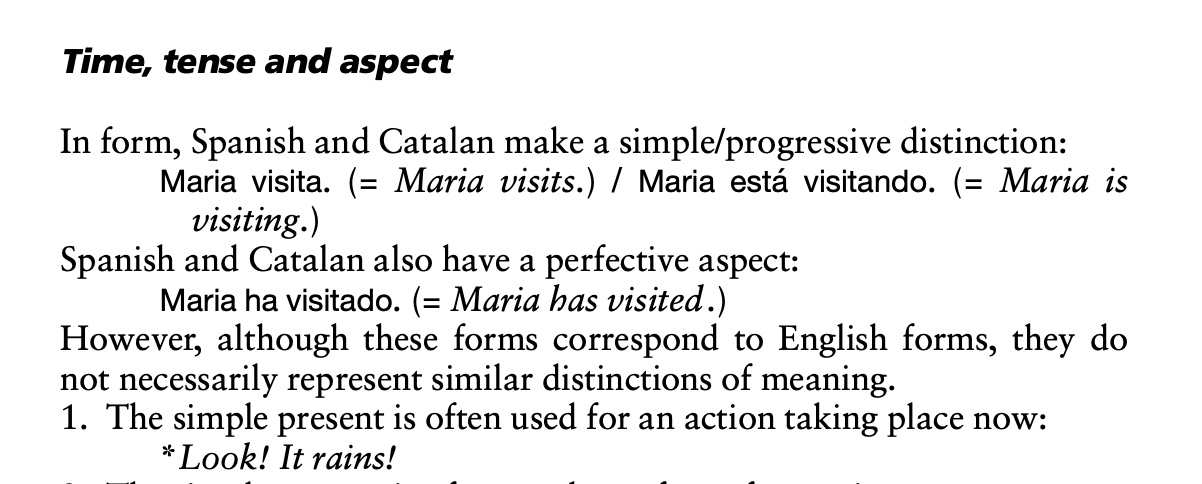
This can be very helpful on the ACT® because it can tell your son or daughter exactly which mistakes they're making that they may not even be aware of. You can find this book at your local library or available for purchase online.
One thing to be aware of: Swan's Learner English is intended as an aide for teachers. That being said, it can still be extremely useful for students — especially those who are motivated to self-study.
Math
Math can be seen as the strong suit of many ESL students. According to them, math is math in all languages. And they're not wrong. But that's especially helpful on the ACT® Math because a lot of the math questions aren't purely math. They're long word problems.
Native English speakers miss math word problems all the time. They simply disregard the question, can't solve it, and fall for a trap or give up and move on. For ESL students, I think word problems can be very confusing — there's a lot of information to keep straight, as well as the increased burden of translating all the words.
So the best advice I can give to ESL students on math is actually the same as the advice I give to native speakers: make sure to heavily annotate your math section. Write out the units. Show me all your work, and read the full question. The more you do that, the better your score will be.
Reading
The reading section might seem daunting — it is four passages of English-language reading. Strategy matters the most, no matter how good a student is at reading. Please read the full Reading Strategy section for more information.
There are reading passages with cultural or period-specific dialect. The ACT® reading regularly draws from older American literary fiction. A passage written in 1920s American regional dialect can be a real comprehension obstacle that has little to do with English proficiency. Practicing with real tests can help alleviate this burden.
Science
It's mostly chart and data interpretation. Students still need to read on the conflicting viewpoints passage, but the underlying skill is universal: read the graph, answer the question.
That's if your son or daughter even needs to take the Science. It's not guaranteed that they do. The science is no longer required, and, unless your son or daughter plans on going into a STEM field, you should really ask why you're taking the science section in the first place.
What to Do This Month
The barrier was never your child's intelligence. It's time, confidence, and a test written around defaults a newer English speaker hasn't absorbed yet — and every one of those is something you can act on now.
The single most important step, and the one with a deadline attached: if your child is an English learner, talk to their school counselor about submitting an EL support request in ACT's TAA system before the posted deadline for their test date. The one-and-one-half time approval is the gated support — it has to go through the school and be authorized in advance, so it's the thing to start today rather than the week before the test.
From there, the prep that moves the score is the same prep that works for anyone: the grammar rules, real practice tests, heavy annotation on math, and a reading strategy. A free practice test is the cleanest way to see where your child actually stands, and the English section guide is where the drillable grammar lives.
If you'd like to find out whether ACT scholarships could offset college costs, my scholarship guide walks through it. And if you want a second set of eyes on your child's specific situation — the test-prep logic, the pacing, the confidence piece — that's exactly what I do.
Sources
- https://www.act.org/content/act/en/products-and-services/the-act/registration/accommodations/policy-for-el-supports-documentation.html
- https://www.act.org/content/dam/act/unsecured/documents/ACT-ApprovedBilingualDictionariesList.pdf
- https://industryinsights.act.org/2025/08/act-enhanced-english-learner-support
- https://counselorblog.act.org/accommodations-and-supports-updates-state-and-district-testing