As a former 2e student myself, it was important to me to write this. Being the parent of a twice-exceptional child is hard, because so many people misunderstand your child. I want you to know that I understand you, and I built this entire platform for you.
When it comes to the ACT, twice-exceptional students lose points the rest of the test-taking population doesn't. They have the strongest claim to accommodations of anyone, and usually the weakest documentation. There is a growing body of research on the 2e population, but standardized tests and test-prep companies have yet to take notice. That's part of where I come in.
What is a twice-exceptional student?
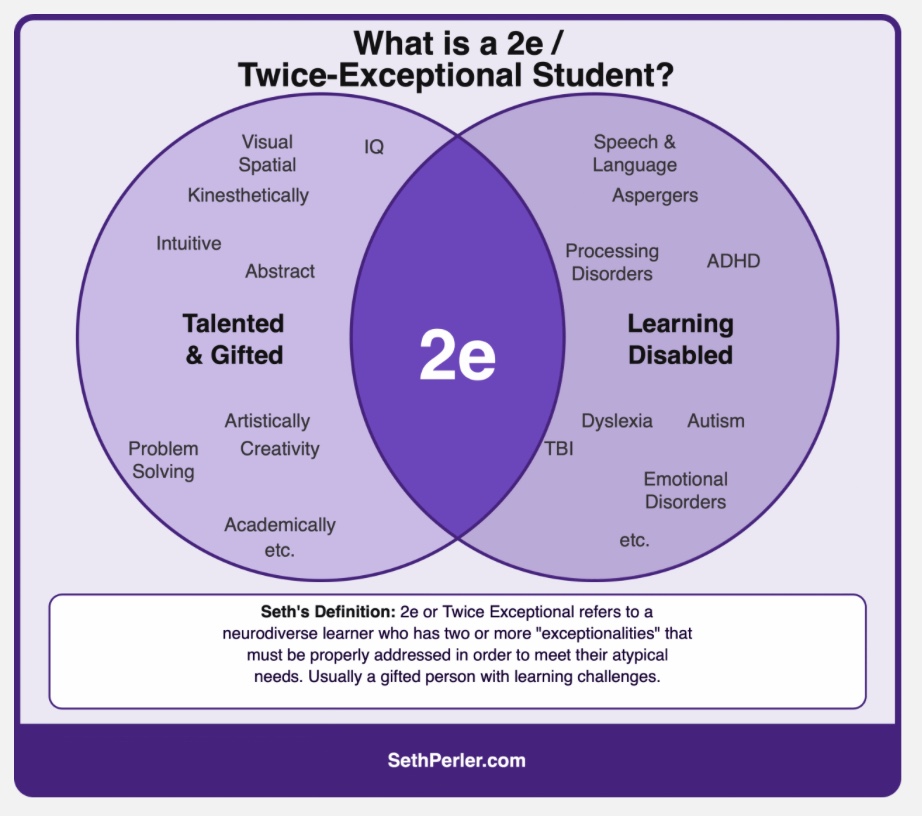
Twice-exceptional students are gifted students who also have a learning difference. 2e kids, believed to make up at least 6 percent of all students who have a disability, possess high academic aptitude but struggle with ADHD, mild autism, dyslexia, or other learning and behavioral challenges.
The NAGC's three subtypes are:
- Gifted but disability unidentified, read as lazy underachievers.
- Disability identified but giftedness missed, stuck in deficit-focused programs.
- Neither label, passing as average with deflated scores.
I'd add a fourth, hopefully a burgeoning category: gifted and disability identified. Because of the paradox of being both gifted and having a learning difference, so many programs refuse to provide the accommodations your son or daughter needs.
The 2e accommodation paradox is real, and it's brutal
Nobody in the test-prep space is really talking about it. In recent years, parents have begun to be more vocal about their struggles getting 2e accommodations. I'm sharing some stories I found online, because I think they'll resonate with you in a way that provides comfort and, hopefully, encourages you as you keep fighting for your child's needs.
One mother shares her struggle to get her son diagnosed:
Military doctors dismissed her son's struggles as “just being a boy” for seven years, during which he showed behavioral issues and missed assignments. After she finally sought an evaluation, doctors diagnosed him with ADHD and ASD. About a year after he was placed on a 504 plan, she learned through a local special-needs group that she had the right to request an IEP meeting based on his diagnosis and continued struggles. The school denied the meeting twice, citing his “academic competency”: his test scores were well above average, so in their view he didn't require educational accommodations. His inability to focus, stay organized, and hold working memory apparently didn't count as impeding his education.
Another mother corroborates that account and names the specific paradox that holds 2e students back:
Her son's grades and high test scores proved he could “access the curriculum,” so meetings with his principal went nowhere. She spent thousands on therapy and evaluations and still couldn't get him an IEP. He was caught in the middle: under-stimulated by the curriculum and struggling to meet too-high social and emotional expectations. When she tried a gifted-and-talented program for middle school, he wasn't accepted, and she was told there were concerns about his “impulse control.” He'd been denied services for years because he was gifted, and now he was being denied a gifted program because he had ADHD.
These stories might help you understand that you're in the right place for 2e-specific test prep. If you're not sure whether your child is twice-exceptional, or you don't have formal documentation yet, I'd strongly encourage you to start the process now.
ACT prep for twice-exceptional students
First of all: accommodations
Accommodations on the ACT exist for students who need them. Please don't disadvantage your child just because you want them to be seen as “normal.” The analogy I use is a polar bear in the desert: it's an apex animal, but drop it in the desert and it can't do anything. In its own environment, it's second to none. That's the situation we want to create for your child. For the full process, see how ACT accommodations actually work, and if you want to know whether your child is even eligible, start with does my child qualify for ACT accommodations.
Here are some of the most common accommodations for 2e students. Because 2e is giftedness plus a learning difference, the actual accommodation depends largely on the specific learning difference.
- National testing accommodations run on a normal Saturday at a regular test center. The big one is 50% extended time (time-and-a-half), the most-requested support, granted for documented processing speed, ADHD, or dyslexia. Also in this tier: a small-group or separate room, permission for breaks, and large-print or large-text formats. See how to get extra time on the ACT for the documentation specifics.
- Special testing accommodations can't be delivered on a national test day, so they run at the student's own school over a roughly two-week window. This is where 100% extended time (double time), multi-day testing, a human reader, a scribe, Braille, and adjusted pacing live.
- Adjusted pacing and regulation supports are for students whose disability requires physical or mental regulation during the exam.
If the school won't generate the paperwork, you're not stuck. Here's what to do if your child's ACT accommodations get denied.
The actual study plan
My precision point map covers only the material a student has been proven not to know. I get there by looking at two axes.
The first is the score band. Is the student at a 20–23? A 33–36? Those are two totally different ranges, and each one pairs with the second axis.
The second is sub-content areas. An English score in the 33–36 band tells us exactly where to look: at the specific subcategories within the English test. There are three, and they're printed on the score report: CSE, KLA, and POW. But those subcategories have sub-subcategories of their own.
- CSE has SST (Sentence Structure), USG (Usage), and PUN (Punctuation).
- POW has TOD (Topic Development) and ORG (Organization).
- KLA has just KLA.
So if a student is at a 33 and wants a 36, I can assess whether any content is unknown just by breaking down each category. Not only is this the most efficient way to prep any student, but 2e students love this approach, because they can see exactly what the sub-tasks are and how each one is relevant to the goal of a higher score. Personally, I love it too. You can see the full band-by-band breakdown in how to get a 36 on the ACT.
Careless errors
Once we've figured out whether your student knows the requisite information, we move to careless errors. 2e students are specifically prone to them, for a variety of reasons that often depend on the specific learning difference. Students with ADHD, for example, often get read as “careless” when inattentiveness is simply the way their brain works. Your child may already be quietly compensating in ways you can't see, and here are the signs.
Private tutoring vs. group classes
Most students don't benefit from group classes, yet parents still pay serious money for them. That's because teachers have to teach to the middle, and in any given class students are spread all across the score spectrum, from a 19 to a 33 composite.
This is especially true for 2e students. They need help that group classes, by their very nature, can't provide: an instructor who can read their specific error pattern and not write off the gifted score as the whole story. I make the full case in group vs. private tutoring.
Test-optional doesn't mean test not required
Most schools are returning to test-required anyway, since test-optional policies have been shown to hurt low-income families the most. For 2026–2027, the test-optional message no longer holds at the schools these families care about. Princeton is test-optional for one more cycle, then required. Columbia is the lone Ivy holdout. This is a real strategic update gifted families need, and a lot of older online content still says otherwise. If your child is 2e, please start making a plan to get a high ACT score now. The content on this site is a great place to begin, including the complete guide to the Enhanced ACT and what score your child actually needs.
National Merit is back on the table
National Merit is back as a scholarship lever for the gifted middle. The Class of 2026 commended cutoff was 210; Semifinalist cutoffs ranged from 210 in low-cutoff states to 225 in New Jersey, Massachusetts, and DC. Finalists need a confirming ACT or SAT score, so the ACT prep work feeds the National Merit scholarship work directly. Some state and corporate scholarships still attach to Finalist status. For a gifted student, this single award could pay for the entire cost of tutoring. The best guide to ACT scholarships has the National Merit section in full.
What to do this month
If your child is gifted with an identified learning difference, start the accommodations paperwork now and read what to do if accommodations get denied before you need it. If you suspect a learning difference but have no diagnosis, the careless-error pattern is worth taking seriously: many gifted kids who can't break a ceiling turn out to be 2e and don't know it. If you have a specific diagnosis already, the targeted guides go deeper, like ACT prep for students with ADHD. Whatever the profile, the next step is the same: a plan built around your child's specific strengths and specific errors, not a class calibrated to the middle.