ACT® Prep for Students with ADHD
Read time: 12 min · Last updated: June 19, 2026
Preparing for the ACT® with ADHD is hard. My name is Alex Charles. I’m an expert tutor who has helped hundreds of students. I specialize in accommodations and disability advocacy. This guide is custom tailored to help students with ADHD increase their scores by working with their diagnosis - not against it.
The main take aways:
- ADHD is by far the most common reason why accommodations are approved
- The new Enhanced ACT® is friendlier to students with ADHD
- There are several specific study methods that help students with ADHD succeed on the ACT® and beyond - in high school, in work, and in college.
ACT® Accommodations for Students with ADHD
Congress wanted to know how private entrance exam companies were supporting students needing accommodations. So in June ‘22, the United States Government Accountability Office (GAO) released a report. The government was looking at all standardized tests: ACT®, AP Exams, GMAT, GRE, LSAT, MCAT, PSAT, and SAT. There’s no clear data on the ACT® alone, but from my experience, I’d say it’s safe to extrapolate from these numbers.
According to the GAO report, nearly a quarter of accommodation requested and granted were for ADHD.
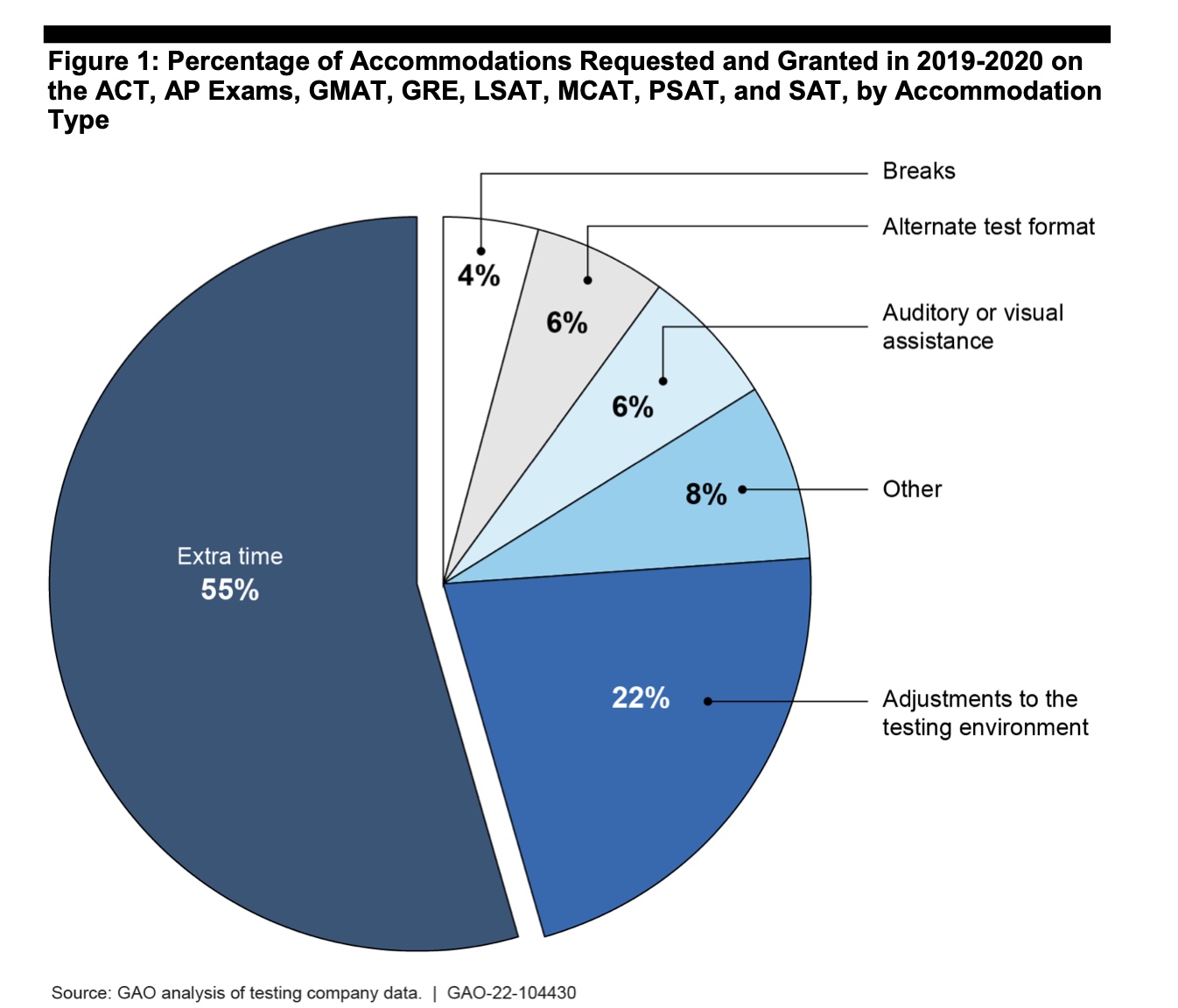
Additionally, there are a number of different accommodations I’ll get into below. The takeaway is that the most common one, according to the GAO report was extra time.
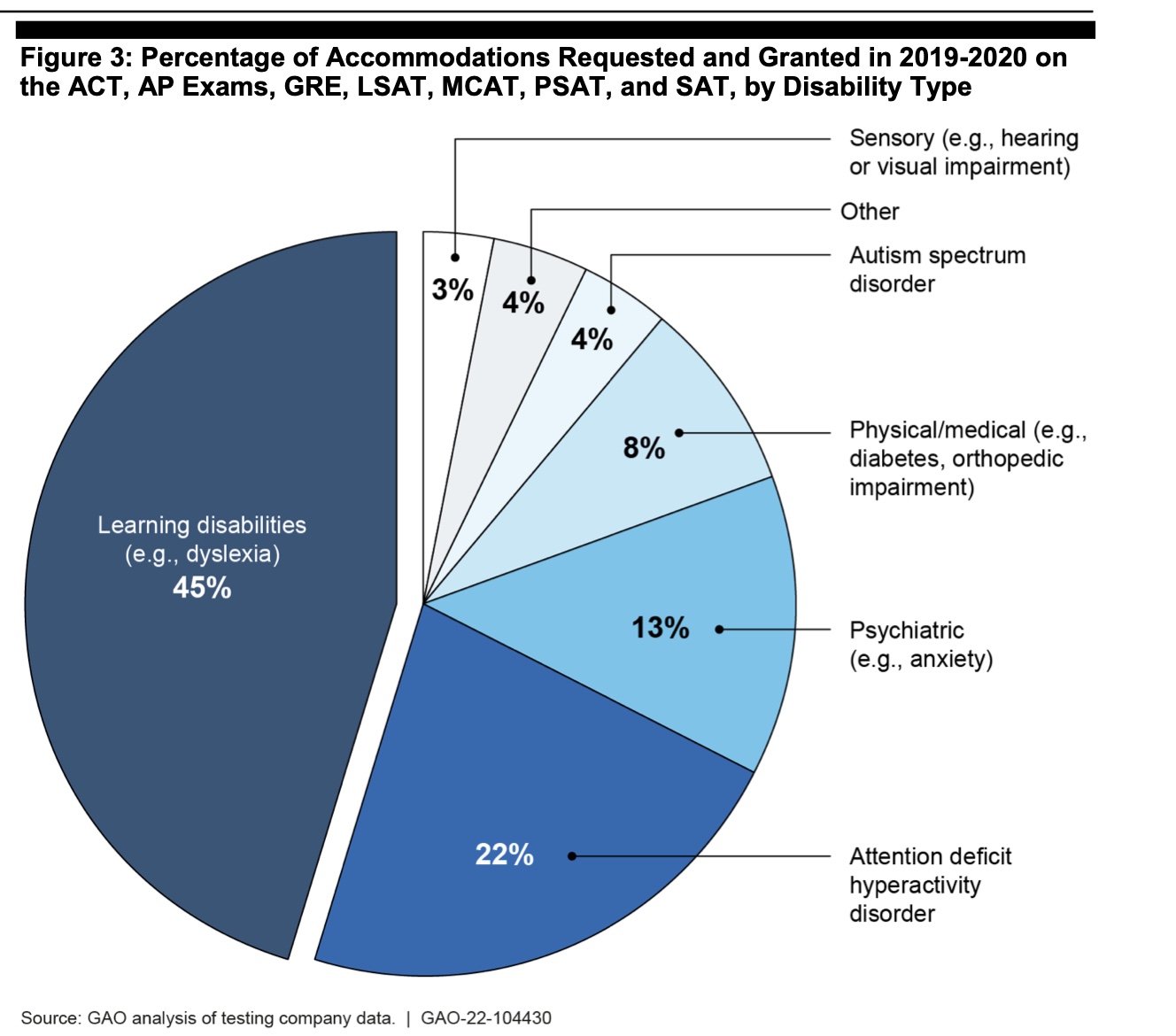
So if your son or daughter has been diagnosed with ADHD (or you/they suspect it), the good news regarding accommodations is this: there’s a clear path to receiving the support your kid needs, and it is routinely granted. For the full picture of how the process works, see what most parents don’t know about ACT® accommodations.
Will colleges know we had accommodations?
Short answer: no. Medium answer: Colleges, no. Service academies, yes. So you can go to West Point, US AF Academy, US Naval Academy etc. with accommodations. Longer answer:
Colleges used to learn if your son or daughter had accommodations by default, but there is no longer any mechanism for colleges to learn whether your son or daughter has accommodations from the ACT® or SAT. I’ll elaborate a little on this point because there’s a lot of confusion on this topic.
“In 2003, the College Board (SAT) and the ACT decided to drop the ‘flagging’ of non-standard testing because it was discriminatory against students with disabilities. Since that time, colleges have had no way of knowing who uses extended time in testing. All tests – those taken under standard and non-standard conditions – are viewed in the same way.”
However, the ACT® still has a pre-test questionnaire where students could self-identify as having a disability. The ACT® used to send this information to colleges by default, but as of 2018 it no longer does.
Aren’t Accommodations an Unfair Advantage?
No. They are not. And it’s worth clearing this up with your son or daughter - on test day, the proctor will ask the entire class “who has accommodations.” Your kid may have to raise his or her hand in front of their entire class. I’m telling you this because the emotional register of using accommodations is real. So arm your kid with the facts.
A 2003 College Board study showed: “students who did not need extra time improved their scores by no more than 10 points in Verbal (CR) and 20 points in Math when given extended time, whereas students who had been diagnosed learning disabilities increased their scores by 45 in Verbal (CR) and 38 in Math with extended time.”
That sounds right. In 2003, the SAT was scored out of 1600. A 10-20 point difference is a statistical error; that is to say, a 10-20 point difference is the exact sort of fluctuation a child sees in their score between one day and the next, whether or not they had extra time.
But the take away above is even more important. Students who were given extra time outside of accommodation reasons only improved their scores by a hardly reportable number. That study corroborates what any tutor worth their salt knows: if a student doesn’t know their content, extra time won’t help with a thing. UNLESS a student needs accommodations, in case they should get those accommodations because the student literally needs them.
How can I get accommodations for ADHD on the ACT®?
First of all, you need a formal diagnosis from within the past three years. So if you don’t have one, you should get on the phone with a psychologist immediately - getting a formal diagnosis will help your son or daughter in myriad ways beyond the ACT®.
“College Board requires that all educational and/or neuropsychological testing for learning disabilities and ADHD be conducted within the last five years... ACT requires that all educational and/or neuropsychological testing for learning disabilities and ADHD be conducted within the last three years.”
So a family with a 5-year-old eval needs to redo testing for the ACT® but might still be fine for the SAT. Important for budget and timing.
Specifically for the ACT®, your son or daughter needs the following sort of diagnosis. This information was taken directly from the ACT®’s own accommodation documentation in June of 2026.
“For mental impairments, including learning disorders and ADHD, ACT follows the guidelines of the Diagnostic and Statistical Manual of Mental Disorders, 5th Edition (DSM-5).”
Required documentation for ADHD includes:
- Original diagnosis (e.g. date/age/grade, diagnosing professional, symptoms/impairment, course of treatment, and educational/behavioral/social interventions);
- Evidence of childhood onset before age 12 (symptoms of inattention, hyperactivity, or impulsivity demonstrated in two or more settings);
- A statement of presenting problems;
- Relevant testing using reliable, valid, standardized, and age-appropriate assessments.
Specific ADHD subtype required: “ADHD-Predominantly inattentive, ADHD-Predominantly hyperactive/impulsive, ADHD-Combined, ADHD-NOS, or Unspecified.”
Number of applicable DSM-IV or DSM-5 criteria and a description of how the criteria impair the examinee (e.g. measurable impairment in academic achievement, social functioning, sports, extracurricular activities, employment, clubs, daily adaptive functioning, and/or executive functioning. Failure to finish timed tests cannot be used in isolation to demonstrate impairment.)
Notice - and this is a big one - failure to finish timed tests cannot be used in isolation to demonstrate impairment.
That single sentence has killed a lot of accommodation requests. Parents document that their kid runs out of time on tests and assume that’s enough. It isn’t. The documentation has to show impairment across multiple settings - academic, social, family, extracurricular. But kids with ADHD have an impairment across these multiple settings, so it’s usually just a matter of ensuring the documentation reflects that.
Official ACT® source documents:
The ACT®’s specific ADHD-friendly accommodations
Most articles focus on 1.5x extra time. The ACT® actually offers a wider menu, and several are under-used.
The multi-day testing option
The SAT doesn’t really have this - they do, and they don’t. Their information really isn’t clear, so you have to kind of read in between the lines. (See the College Board’s testing-staff page.) But the read is that the SAT allows multi-day testing as a function of extra time. A student with double time tests over two days, while a student with more than double time tests over several days.
The ACT® decouples multiple-day testing from double time.
“Another accommodation to consider is the multiple-day testing available for the ACT. This is tailor-made for students with ADHD who fatigue easily when sitting for any length of time.”
“This opens up possibilities not only for those who need extended time but also for students who do not need extended time but work best in a short, concentrated period of time. It also allows students with poor working memory to review each section of the ACT individually, focusing on one subject at a time. Students who could not sit for the 5 hours 45 minutes, even with breaks, also benefit from the multiple-day option. The students are allowed to leave the testing room as soon as they finish.”
This is one of the most underused ADHD accommodations on the ACT®. Talk to your psychologist to see if this sort of accommodation might help your son or daughter on test day.
Other under-used ACT® accommodations for ADHD:
- If your child has difficulty tracking, you can request that they answer in the test booklet rather than on the Scantron (bubble) form.
- Separate, distraction-reduced testing room is for students who need a quieter environment.
- Breaks between sections are for students with certain medical conditions or attention needs. Stop the clock or extra breaks.
You need to consider what sort of accommodation your son or daughter actually needs. Just because he or she has ADHD doesn’t mean 50% extended time is the right move. In fact, making a student sit for longer can be detrimental to their success. Instead, getting more mental breaks during the test to move around and clear their head could be the key to success. It all depends on the actual student’s diagnosis.
The enhanced ACT® can be better for students with ADHD
This might be somewhat of an overblown claim at a technical level, which is why I want to hedge on this one, but on an emotional level, the impact might be real. The ACT® was purchased several years ago by a private equity company that formed a public/private partnership with the ACT® org. Basically, ACT® enrollment was down, so they tried to figure out how to get more students to take the test without compromising its integrity. Enter the “Enhanced ACT®.” For the full breakdown, see my complete guide to the Enhanced ACT® in 2026.
The Enhanced ACT® is a shorter test with fewer questions. Fewer questions mean less mental fatigue and less time to get distracted.
“With shorter overall testing time and more minutes per question, the new ACT is designed to help students pace themselves without feeling rushed. Instead of racing the clock, test takers have more space to slow down, think carefully, and avoid careless mistakes. This shift creates a calmer and more focused experience, which not only reduces stress but also helps maintain focus throughout the entire exam.”
The 18% more time per question, the optional Science section (drop one full section of fatigue), and the shorter Reading passages are all can be really impactful for students with ADHD to hear. A student with a lower-than-wanted score almost always has a knowledge gap problem - even if they don’t understand that. So the ACT®’s enhancement can be encouraging from a stress management perspective, absolutely, but the ACT® is still the same ACT® as it’s always been from a content and mechanical perspective.
Tutors generally disagree about which test - ACT® or SAT - is better for students with ADHD. If a student needs accommodations and is taking AP classes, it might make more sense to get College Board accommodations which will be accepted on both SAT and AP exams.
People perennially debate whether the SAT or the ACT® is easier - there’s no way one could be harder from a technical stand point when the tests have concordance tables. Meaning a 36 on the ACT® is a 1600 on the SAT. Each test tests the same knowledge and content. Students might emotionally feel like the ACT® or SAT would be easier for them - but then when they try the other test, they find that their scores are exactly the same (on a concordance basis). If your family is weighing the formats, my guide on digital vs. paper ACT® walks through that decision too.
Test prep strategies for students with ADHD
“Outside” Schedules
Timeblindness is a consistent feature of ADHD. Consistent “outside” schedules and structure have been shown to help. Timeblindness is losing track of time. It means both that students can do a short task that feels like it takes forever or a long task can feel like it took no time at all. That’s why “outside” schedules help: they tell a student how long they’ve actually been studying. Maybe 30 minutes a night is sufficient to study; setting a timer will help your son or daughter gauge how much time has actually passed.
Structured Study Schedule
Regarding structure, my precision point map gives the most efficient test prep route for any student to prepare. I’ve used my ten years of experience, including experience writing books for major test prep organizations such as the Princeton Review, along with the ACT®’s technical documentation to outline each student’s knowledge gaps. That way they only cover the mistakes they make, which reduces the cognitive load of someone with ADHD. It also increases their motivation to study, since a core feature of ADHD is novel experience seeking - what could be more novel than things you’ve been proven not to know?
Learning Best Practices
Active recall and spaced repetition help every kind of brain learn. Since students with ADHD can be at a specific disadvantage when it comes to concentration, learning how to most easily learn is of critical importance. Two key facts stand out.
Spaced repetition: Review material over increasing time intervals
A 2006 quantitative review of 254 studies involving over 14,000 observations found that studying something over several days - rather than all at once - increased a subject’s ability to recall information. This makes sense. It also spells out why studying for the test with little time to prepare is suboptimal. Every sort of brain needs time to learn things, and you can’t speed that up - no matter what. So create a study schedule that allows for spaced repetition.
Active Recall
The other important piece of information from psychological studies is that active recall and spacing are multiplicative, not additive. Karpicke and Roediger (2008) found spaced retrieval practice led to a roughly 150% improvement in long-term recall compared to massed study, and Karpicke and Blunt (2011) found retrieval practice combined with spaced intervals produced the highest long-term retention across all conditions tested.
Meaning not only does spaced retrieval help, but so does active recall: quizzing oneself rather than reviewing notes. The format of a standardized test makes the active recall portion easier. It’s important to point out that reviewing notes does not help with active recall, so the majority of studying should not be that. My ACT® Math strategy page and Reading strategy page are built around exactly this kind of active practice.
Executive Function
Neurodivergent students tend to struggle with executive function. Showering, cleaning, studying. It’s because their brain is not wired for mundane experience. For a while, I tried to fight myself about this until I realized my brain simply is not wired that way. When I started to negotiate between how my brain is wired and what needs to get done, I found a lot of results. I believe this works for most other people too.
Neurodivergent, but particularly ADHD, students struggle to get started. Their brains are wired to seek novel experience because their neurotypical dopamine wires simply don’t exist. So something that seems boring or repetitive can be really challenging for students. And what can seem more boring and repetitive than a literal standardized test? To be clear, I don’t think the ACT® is nearly as boring as the general population assumes, but that’s because I don’t make it boring.
Regarding students with ADHD, however, the specific salve to executive function is not to prepping alone. Instead, prep with a tutor. ADDitude (the ADHD parents’ magazine of record):
“For students with weak executive function skills, we do not recommend prepping alone with a test prep book, or even in a group setting.”
If your family can’t afford to hire a private tutor, then use the resources on this website to help your son or daughter prep. The point is that active studying can lead to better results, especially for a student with ADHD who more likely than not struggles with Executive Function. If cost is the barrier, my scholarship program offers free tutoring to a small number of students each year.
Strategic skipping
“Since focus tends to fluctuate, students should tackle easier questions first and mark harder ones to return to. This reduces frustration and prevents getting stuck on one problem for too long.”
This is also just a standardized test prep best practice - see ANY of my strategy pages. The important caveat on this one is to ensure students come back to the questions they skipped. They can wait until the end to fill out their Scantron to ensure they didn’t miss any questions - but if they run out of time without filling out their Scantron, then they get no points. It’s really important to find a solution that works for your son or daughter.
The medication question
I’m only writing this question because parents tend to ask about it. I’m going to keep things very brief because I am not a doctor, this is not medical advice, and I’m never in any position to give any such advice.
That being said, IF your son or daughter is on medication normally, test day is not a day to skip medication. Please consult with your doctor if you have any questions.
The emotional dimension of preparing for the ACT® with ADHD
A lot of students with ADHD don’t want to use accommodations even when they’re approved. They don’t want to be in a separate room. They don’t want to feel different. They’ve often spent years masking their ADHD at school and the idea of “needing extra time” feels like admitting weakness.
Workplace disability advocate Daniel Wender likens having ADHD to being a polar bear in the desert. You’re an absolute apex animal, but you’re in the totally wrong environment. Accommodations put your son or daughter back in the right environment.
So remember:
- Since 2003, the score report shows nothing about accommodations. Colleges don’t know. And since 2018, there’s no way to self identify to colleges.
- Accommodations level the field for the student who has a documented disability - they don’t give an unfair advantage (the 2003 College Board data above proves this).
- The student who refuses accommodations and scores below their actual ability has just made the same mistake as the student who refuses glasses on test day and squints at the page.
If you want to go deeper on how to approach this with your child, my pillar on ACT® accommodations covers the conversation in detail.