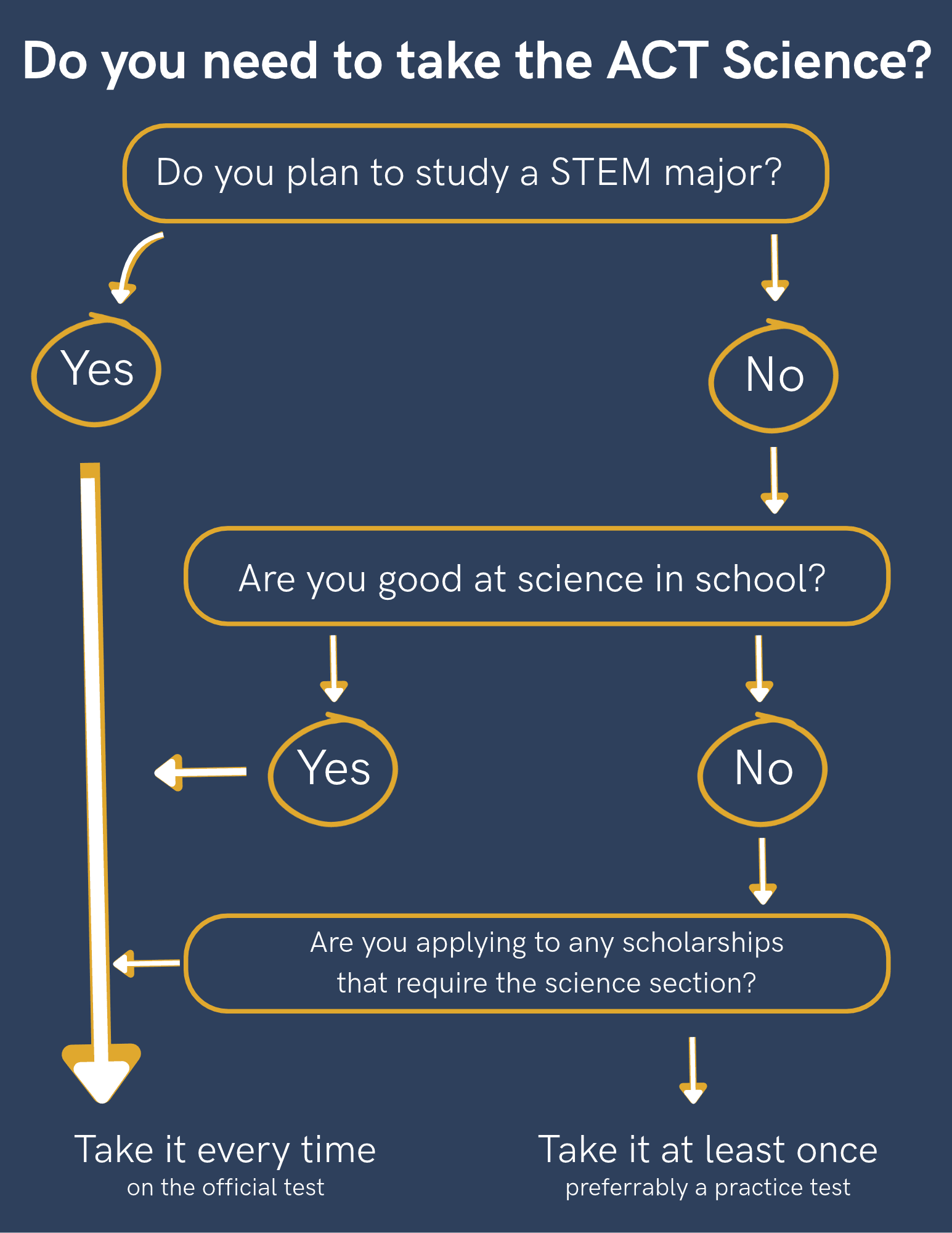
Here’s how to decide:
- Does any school or scholarship on your child’s list require or strongly recommend the ACT science section? If yes, then plan on having them take it.
- Is your student strong in science, or considering pursuing a STEM major? Have them take a practice test, and if the science score is good, have them prepare to take the science test on the official exam.
- In all other cases, they can skip the ACT science and spend the prep time on the other three sections.
Does skipping the ACT science section hurt your son or daughter’s composite score? No. The ACT composite score does not factor in the science section. But some colleges want students to take the science section. Have your son or daughter take the ACT science section at least once, preferably as a practice test. The rest of this article will break down how to make the decision, since it’s actually one of the most nuanced decisions to make when it comes to standardized test prep. One school on your list requiring it means your son or daughter is taking the science section.
International students especially have trouble getting solid advice on whether to take the science section. Many international students worry that not taking the science section will hurt their score or their admission chances in some way. But there’s no evidence to back up that worry - there’s no conspiracy to hurt their scores. And on average, from my experience, most international students taking the ACT are at an advantage when taking the science section.
There’s no actual science on the ACT Science section
The biggest misconception I see is that students think there’s science on the ACT science section. I know it seems like there would be, because it’s called the science section, but there’s not. I promise.
Let me explain. Despite the name, the ACT® Science section has always been a data-interpretation and reasoning test, not a content test. The science section involves reading graphs, analyzing experimental setups, and drawing conclusions from conflicting data. There's almost no actual chemistry or biology or geology or physics or any science knowledge actually being tested.
There are some “outside science knowledge” questions, but they’re 1-2 questions a test. Topics tested include: order of the planets, boiling point of water in celsius, species classifications, etc. If your son or daughter doesn’t know these things, he or she can learn them in a night. This opinion, of course, comes from my 10+ years of experience teaching these tests.
The harder problem to solve is learning how to do the ACT science questions. The process is extremely similar to how to solve questions on the other sections. After seeing the English, math, and reading sections, the science section is incredibly easy to do. It asks questions in the same way all the other ACT sections do. Students are usually nervous but surprised when they get to the science section, because it’s truly not that difficult for them, and they don’t know what to expect beforehand.
Here are some actual examples of the ACT science section.
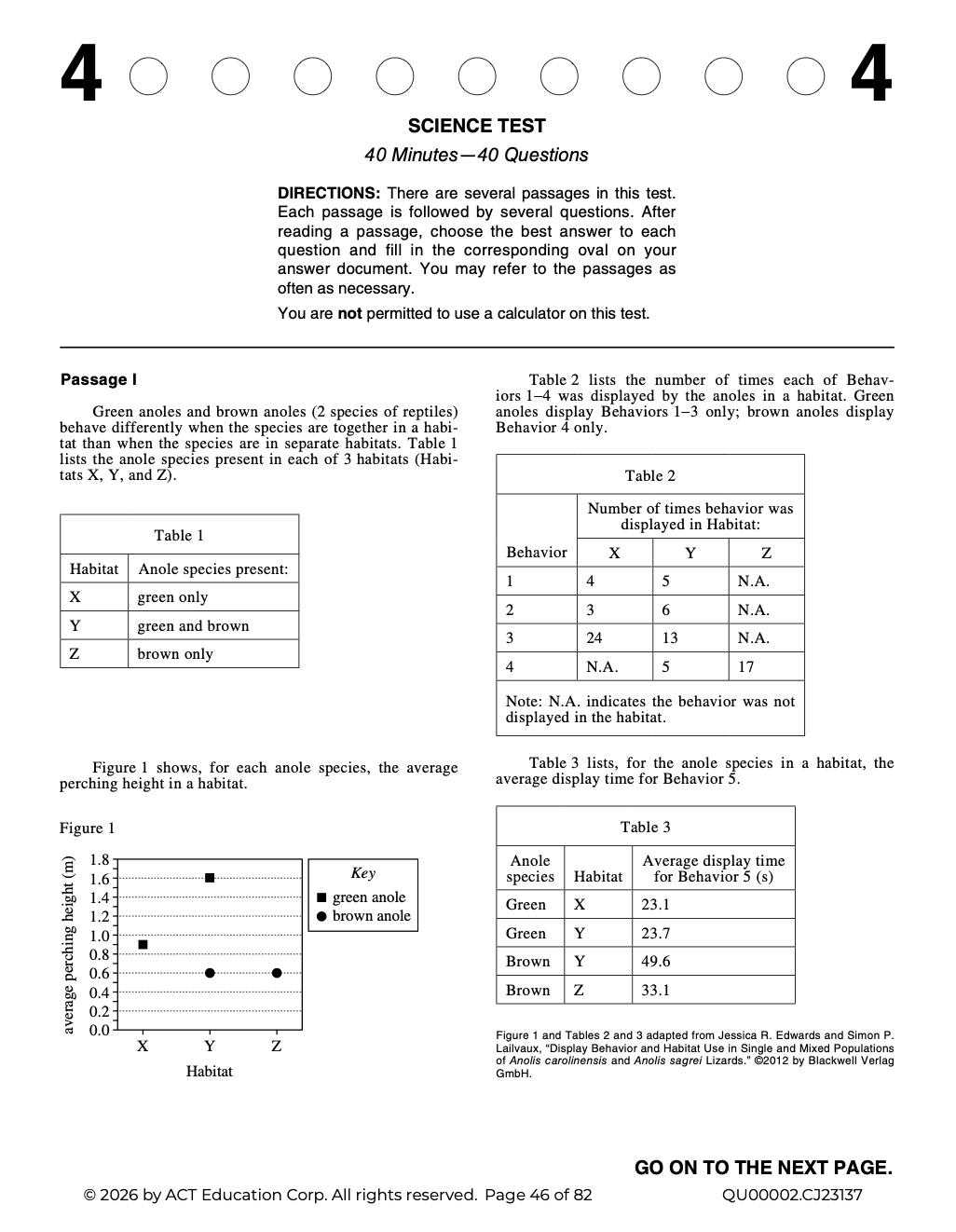
This example shows tables and charts for a typical ACT science passage.
The questions then look something like this:
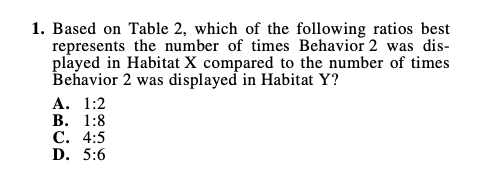
The question just wants students to compare the X and Y habitat in Table 2. That’s all.
The SAT does have science
Contrary to popular belief, the SAT does have science. It’s just buried in the Reading and Writing section. Here’s an example:

The question wants you to look at a table and complete a conjecture. While it’s not 1:1 a formal science section, the SAT still very much has science questions interspersed throughout the test. Again, while the SAT does not have a formal science section, it does have science questions. If your son or daughter is looking at taking either the SAT or the ACT, the science section shouldn’t be the deciding factor. Follow this link to read more about taking the ACT or the SAT.
And if your son or daughter already needs help on the science section, check out this page on the ACT Science Strategy
Which schools actually require the science section?
The most important takeaway from this section is that there's exactly one reliable source of truth: the college itself. Everyone in this space agrees on that one thing. The second most important takeaway is that one school on your son or daughter’s list requiring science scores means your son or daughter is taking the science section.
If your child wants to pursue a degree even remotely related to STEM - and you’ve decided on them taking the ACT - your son or daughter will be taking the science section. Basically, every school will “require” the science section, either informally or formally. Meaning, while your child’s intended school may not explicitly state that the ACT science section is required, they should still expect to study and submit that section score. Test optional, test required - it doesn’t matter. That’s because (what other test prep companies won’t admit) standardized tests are only one important part of the college admissions equation. And if a student is strong in science, admission counselors may ask why the student didn’t submit a science subsection score. It’s not a huge concern, but such a question should factor into your thinking.
For everyone else whose son or daughter is not intending to study STEM, here’s what you need to know. The most credible piece of original research here is Edison Prep's survey of more than 250 universities. They found the science section has effectively died at 95% of schools - a quick death compared to the decade-long fadeaway of the ACT® essay. Edison Prep found that aside from a small handful of colleges, 99% of institutions won't require science for the class of 2026 and beyond. I’m tracking test-optional admission policies and find that such a science-optional prediction may not hold in the future.
There's another survey from North Avenue Education (223 universities) that puts the "required or strongly recommended" number closer to 30%. Edison Prep and North Avenue Education are measuring two different things: “Don’t require” vs “require OR strongly encourage.” The “strongly encourage or require” is the number parents should focus on, since it’s the most useful heuristic. Just because a test doesn’t require the science score doesn’t mean it’s not strongly encouraged.

Here’s a useful list of colleges that do or do not require the ACT science in 2026.
- Requires science: Boston University, Georgetown, Pomona, Marquette, and all the service academies (Naval, Air Force, etc.). George Washington's BA/MD program too. (Marquette has a quirk worth knowing: skip science and you have to apply test-optional - they won't consider your ACT® at all. )
- Strongly recommends: Duke, Michigan, Michigan State, RIT, Johns Hopkins, and per some trackers Carnegie Mellon. MIT says science isn't required but tells every family to take it anyway.
- Doesn't use it: most of the Ivies, Stanford, Georgia Tech, Caltech, USC, Penn State, UConn, Virginia Tech, UGA, Colorado Boulder, BYU, Miami, and the whole State University System of Florida.
- Test-blind (no scores at all): the University of California system - though, according to my internal tracking, the UCs may soon reverse their test-optional policy in some regards.
There’s still some ambiguity about how schools require the ACT science section. Consider Georgiatech - they don’t require or consider the ACT science. But most students who submitted ACT scores also submitted the ACT science anyway.
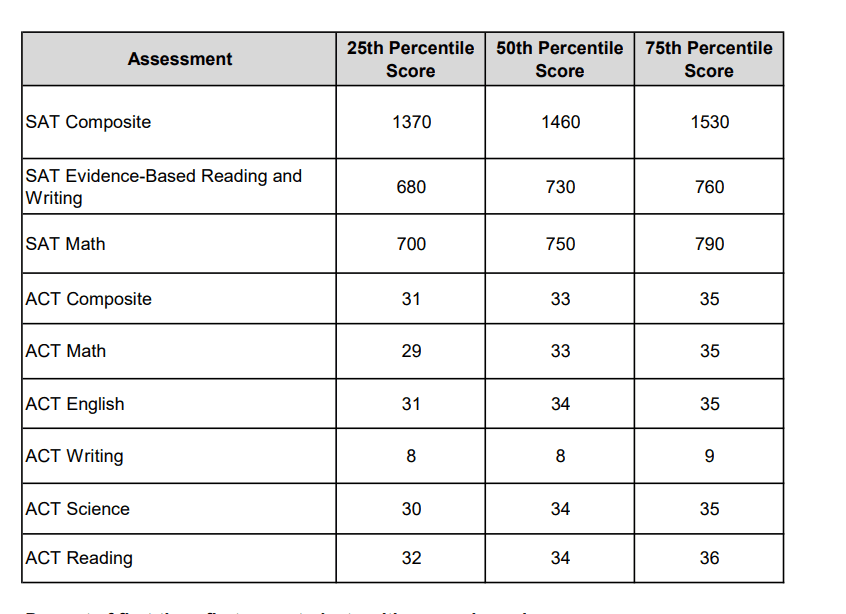
Here’s how parents can check for themselves whether a college considers science section scores:
- Check the college’s admission page first.
- Check the Common Data Set (google [School name] + Common Data Set, e.g. “Georgia Tech Common Data Set”)
- Find section C8 for policy, C9 for what enrolled students submitted.
That will show you actual student behavior. Parents will also notice that a 35 on the ACT science lines up with the rest of the section scores: evidence the science section is not significantly harder for students.
ACT Science for International Students
In my experience, I have seen that international students are at an advantage on the ACT science section because the average international student has seen more rigorous science courses than the average American. This is not a dig at my favorite country in the world, the US of A. It’s simple math: the average international student applying to an American university has simply seen more rigorous science than the average American student. This fact doesn’t raise one’s ACT score that much, but it is an advantage on the outside science questions for international students.
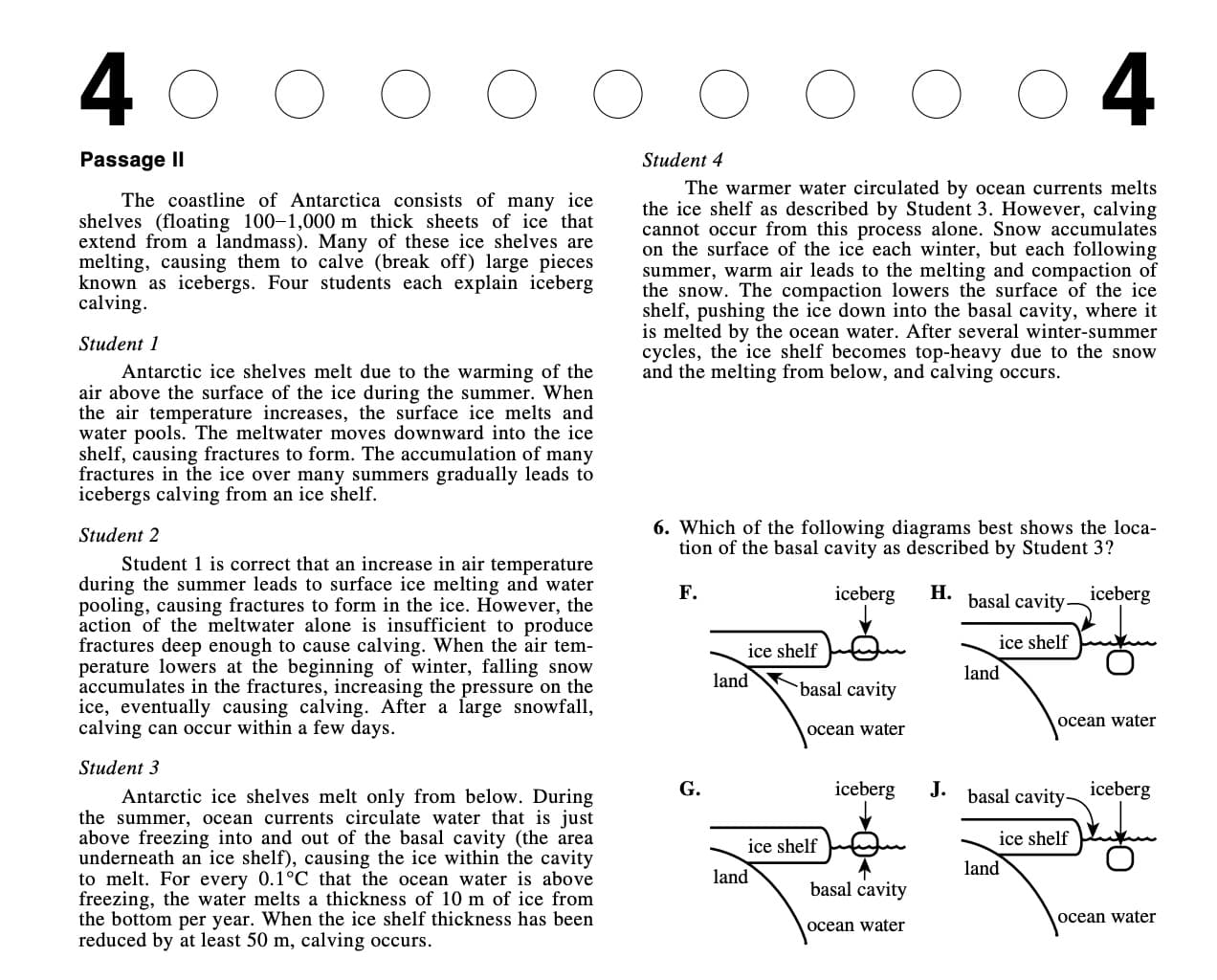
Moreover, since the ACT involves mostly reading charts and graphs, students from other countries with a more ingrained culture of standardized exams are at an advantage. That fact alone gives international students an advantage on the ACT science section. If your son or daughter can solve the very rote reading of charts and graphs, they’ve solved 6/7ths of the ACT science section. That’s because 6 out of 7 of the passages are charts and graphs, while 1 in 7 passages is a conflicting viewpoint passage, where students must evaluate different perspectives on a scientific problem. See the image below for an example.
There’s so much misinformation out there, I need to correct the record.
First, here’s the issue: so much information for the ACT comes from before the 2025 update. Anyone searching in a non-English language will find conflicting information, if they find any information at all. Take a look at this search below: I asked Google in Turkish “Will I be at a disadvantage for applying to American universities if I don’t take the optional ACT science section?” This is the result:

And this is the Google translation (checked by a native speaker):
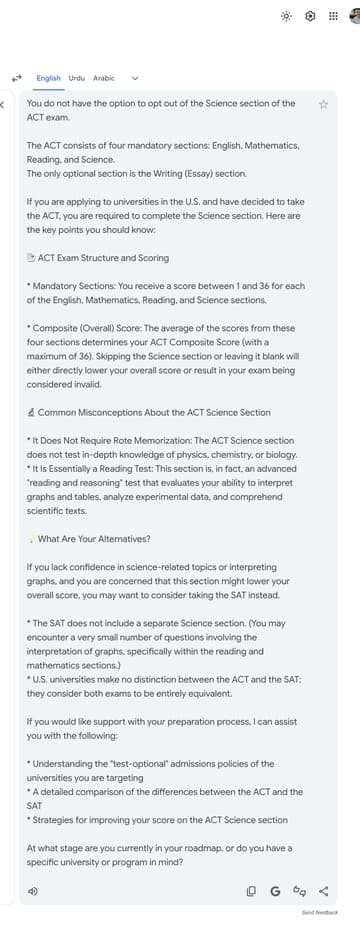
The information in the Google AI overview is wrong. It says that science isn’t optional, when it is and has been since 2025. Moreover, the AI overview says that not taking the science section will seriously impact your son or daughter’s scores, and could lead to their test even being canceled. Of course, this is not true. The information the AI overview has is outdated, and the AI overview is very confidently incorrect. The lack of up-to-date information in foreign languages is some of the source of misinformation among international families.
ACT Science Section for Scholarships
One further thing for parents to know: the ACT science section can be required for scholarships, even if it’s not required for a certain school. That’s because scholarships can be granted from the university itself, as well as from non-university entities.
So let’s leave behind the question about whether the specific college your son or daughter wants to attend requires the ACT science section. The next question is whether an ACT score is required for the scholarship your son or daughter wants to obtain. There’s no hard-and-fast rule. Most scholarships don’t require the ACT science section. Some do, such as the South Dakota Opportunity Scholarship.
Make sure you consider potential scholarships when evaluating whether to take the ACT science section.
Should your son or daughter take the ACT science section?
With all of the above information, it’s time to come back to the question initially posed: should your son or daughter take the ACT science section? You’ve seen that there’s no clear guidance because it’s such a hard question to answer definitively.
The macro reason for the confusion is as follows. ACT test registrations are about half that of the SAT. (1,380,130 ACT registrations according to the ACT Org and 2,004,965 SAT registrations according to the College Board). Additionally, more and more students are taking the CLT. The ACT organization has had to make some changes to remain competitive. From my perspective, the ACT has navigated the change very well: they have retained all of the same question types and content while making the test much shorter and removing the required science test - the two classic complaints students make against it.
The second-order effect of this change is that it’s made any clear guidance on whether to take the science section extremely hard to provide.
The better question to ask is: what do colleges want to see (and is it ACT science scores)? The answer to that question is a lot easier to give, albeit equally as ambiguous: Schools want to see strong extracurriculars, good grades, AP scores, and a high ACT science score if the student is good in science. That’s the most effective guidance parents can receive about whether or not to take the ACT science - it’s part of the overall admissions decision that should be considered.